Where Is the GOFO Regional Hub in Indianapolis, Indiana?
Your GOFO Tracking screen shows a scan in Lebanon, Indiana, and then the page goes still. You ordered something to an Indianapolis address.
The city name on the scan does not match the city on your shipping label, and that mismatch is enough to make anyone wonder if the parcel took a wrong turn.
Quick Answer: GOFO does not list a regional hub inside Indianapolis city limits. Its Indiana hub, coded INDH, is listed in Lebanon, Indiana, a Boone County city on the I-65 corridor roughly 30 miles northwest of downtown Indianapolis.
Indianapolis parcels move through that regional sortation point first, then reach a local delivery station before a driver brings the parcel to the door.
Why the Indiana Hub Sits in Lebanon, Not Indianapolis
A regional hub is not a neighborhood post office. It is a large sorting building designed to move trailers of packages between states and metro areas. GOFO chooses hub locations near highways and freight corridors, not near the customers who receive the parcels.
Lebanon sits directly on Interstate 65, the highway that connects Chicago to Indianapolis and continues south toward Louisville.
A line-haul truck leaving a Midwest gateway can reach Lebanon without entering Indianapolis traffic. That highway access is the operational reason the Indiana hub sits there.
GOFO job postings for Indiana roles list Lebanon, IN as the hub location for sortation, dispatch, and warehouse operations.
The company’s Midwest network also includes a Chicago-area hub in Melrose Park, Illinois, which feeds freight into Indiana before Lebanon sorts it for local routes.
Hub vs. Delivery Station: Two Different Buildings, Two Different Jobs
Most tracking confusion comes from treating every scan as the same kind of event. A hub and a delivery station do different work, and they produce different tracking messages.
A regional hub handles volume across a multi-state area. Trailers arrive full. Packages are scanned, sorted by destination metro or ZIP range, and loaded onto outbound line-haul trucks. A hub does not send drivers to homes.
A delivery station handles volume for one local area. Packages arrive in smaller loads, get sorted by route, and go onto vehicles driven by delivery service providers. A station is the last building a parcel visits before it reaches your street.
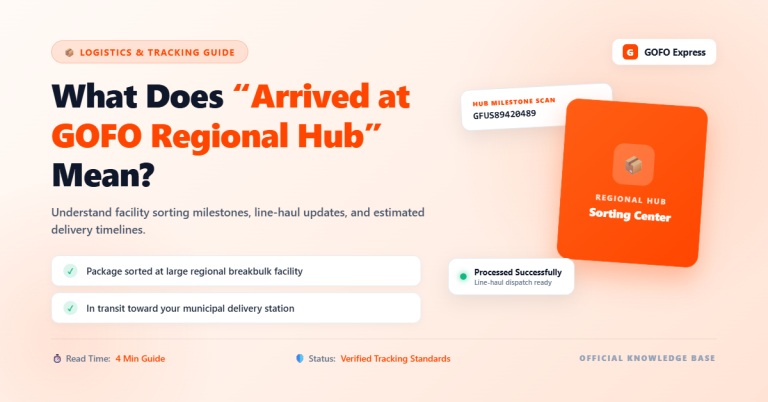
GOFO’s Indiana hub in Lebanon feeds local delivery stations across the state. When tracking shows “Arrived at GOFO Regional Hub,” the parcel is at the Lebanon sortation building.
When tracking later shows “Arrived at GOFO Delivery Station,” the parcel has reached the local facility that serves your address.
What “Arrived at GOFO Regional Hub” Means for an Indiana Parcel
This scan is a location event, not a delivery promise. It means the parcel is physically inside the Lebanon hub and is being processed by destination. It does not mean the parcel is lost, delayed by a problem, or waiting for you to call anyone.
After the hub scan, the next meaningful update is usually “Departed GOFO Regional Hub.” That scan means the parcel has left Lebanon on a truck heading toward a delivery station or another facility on its route.
Gaps of 12 to 24 hours between hub scans are normal because scans update only when a parcel crosses a fixed checkpoint.
If the next scan shows “Arrived at GOFO Delivery Station,” the parcel is at the local Indianapolis-area station. Final-mile delivery typically follows within one business day after that scan.
How Indiana Parcels Move Through the GOFO Network
The routing sequence for an Indiana-bound parcel follows a predictable pattern. The table below maps each stage to the tracking message you will see.
| Stage | What Happens | Typical Tracking Message |
| Origin intake | Seller or warehouse hands the parcel to GOFO at an entry point | “Package Received” or “Label Created” |
| Regional hub | Parcel reaches Lebanon, IN (INDH) for sortation by destination | “Arrived at GOFO Regional Hub” |
| Line-haul dispatch | Parcel leaves Lebanon on a truck toward a local station | “Departed GOFO Regional Hub” |
| Delivery station | Parcel reaches the station that serves the Indianapolis address | “Arrived at GOFO Delivery Station” |
| Vehicle load | A delivery service provider scans the parcel onto a local vehicle | “Loaded on Vehicle” or “Out for Delivery” |
| Final delivery | Driver drops the parcel at the address | “Delivered” |
The Lebanon hub is the middle step, not the final step. A parcel that scans in Lebanon is moving through the network as designed.
How to Read GOFO Tracking Without Overreacting to One Scan
Open the official GOFO tracking page and enter your tracking number. Read the scan history in order, not as isolated events.
Look for the timestamp gap between the latest scan and the one before it. A Lebanon scan followed by 12 to 24 hours of silence is normal. A Lebanon scan followed by no movement for more than three business days is the point where a support request makes sense.
Watch for the delivery station scan as your real progress marker. Once the parcel reaches the local station, the final-mile leg is usually hours away, not days. If the station scan appears and then stalls for more than a day, that is the moment to contact support rather than the moment the hub scan first appeared.
Why You Cannot Pick Up a Parcel at the Hub
The Lebanon hub is a secure industrial work site. It has loading docks, trailer yards, and automated sorting equipment. It is not a retail counter, and GOFO does not allow public pickup at hubs or delivery stations.
This is standard across the parcel industry. A hub is built to move volume between trucks, not to serve walk-in customers. If you need to change a delivery or ask about a parcel, use the contact channels GOFO publishes for recipients rather than driving to a facility.
What Can Slow a Parcel Down at the Lebanon Hub
Several ordinary conditions can extend the time a parcel spends at a regional hub. None of them mean the parcel is missing.
Volume spikes during peak shopping periods fill inbound trailers faster than outbound routes can clear them. Weather can delay line-haul trucks on I-65 or at a Midwest gateway.
Address problems, such as a missing apartment number or an incorrect ZIP code, can trigger a manual check. Customs reviews on cross-border items can hold a parcel before it ever reaches Lebanon.
If tracking shows zero movement for more than three business days, contact GOFO support with your tracking number. A support agent can confirm whether the parcel is still inside the hub or has moved without a scan.
Conclusion
The GOFO regional hub that serves Indianapolis is listed in Lebanon, Indiana, not inside the city. Your parcel moves through that sortation building first, then reaches a local delivery station before a driver brings it to your address.
A Lebanon scan is progress, not a problem. Read each scan as a handoff between facilities, and the quiet gaps on the tracking page become far less alarming.
Frequently Asked Questions
Q. Can I Pick up my Parcel at the Lebanon Hub?
No. The Lebanon hub is a secure sortation facility. GOFO does not allow public pickup at hubs or delivery stations.
Q. Why does my Tracking show Lebanon when I live in Indianapolis?
Lebanon is GOFO’s listed Indiana hub location. Indianapolis parcels pass through regional sortation before reaching a local delivery station.
Q. How Long Does a Parcel Stay at the Lebanon Hub?
Most parcels clear within 12 to 24 hours. Peak volume, weather, or an address check can extend that window.
Q. What Does “Departed GOFO Regional Hub” Mean?
The parcel has left Lebanon and is moving toward a delivery station or another facility on its route.
Q. Who Delivers my Parcel after it Leaves the Hub?
GOFO works with independent delivery service providers who handle final-mile routes and residential drop-offs.
Q. What Should I do if Tracking Shows no Movement for Three Days?
Contact GOFO support with your tracking number and ask for a status investigation. Have the number ready before you call or email.